AI Credits Are Becoming Real Music-Platform Infrastructure
For a while, AI disclosure in music felt mostly symbolic.
Platforms talked about transparency. Companies issued charters. Artists and executives argued about whether listeners had a right to know when AI had been used in a song, a cover image, or a video. Important conversation, sure — but still easy to file under policy theater if you were feeling cynical.
That phase is ending.
Two recent moves make that pretty clear. Apple Music has introduced new transparency tags for AI use in music uploads. Qobuz has announced a policy of identifying and tagging 100% AI-generated content while excluding industrially generated AI music from prominent editorial placement.
Neither move is flashy. That is exactly why they matter.
These are not just statements of opinion about AI. They are workflow changes. Metadata changes. Delivery-spec changes. Catalog-governance changes. In other words: infrastructure.
And once something becomes infrastructure, it starts creating jobs.
Apple’s move matters because it pushes AI disclosure into the delivery layer
Apple Music’s new transparency tags are especially significant because they move the AI question upstream.
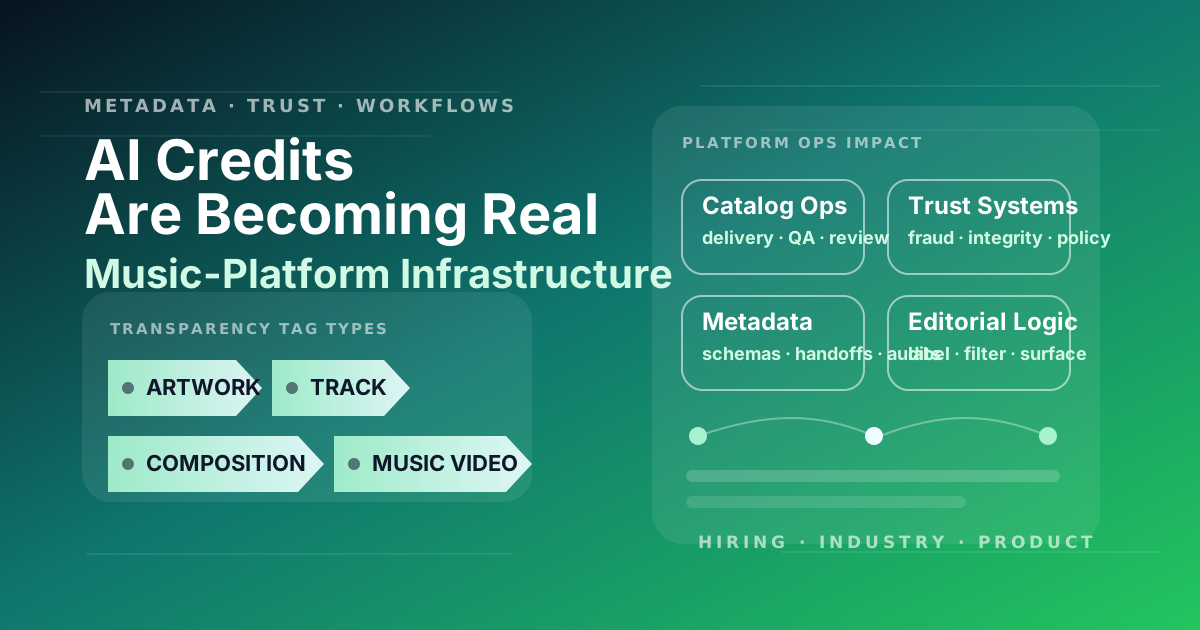
According to reporting from Music Ally, Apple has introduced four tag types for uploaded content:
- Artwork
- Track
- Composition
- Music Video
Those tags are available now and will be required for new content delivered to Apple Music in the future. Labels and distributors are expected to determine whether AI was used in a “material portion” of a work and tag accordingly.
That may sound like a small metadata update. It isn’t.
Once AI disclosure becomes part of a platform’s delivery requirements, it stops being an optional communications exercise and starts becoming an operational problem for:
- labels
- distributors
- artist-service teams
- metadata managers
- ingestion pipelines
- rights and catalog operations
Someone has to decide what qualifies as AI-generated or AI-assisted. Someone has to make sure the information is collected correctly. Someone has to make sure the data survives handoff between systems. Someone has to build product logic around how those tags are stored, displayed, audited, and enforced.
That is not a vibes problem. That is work.
Qobuz shows where disclosure starts colliding with editorial and anti-fraud systems
Qobuz’s latest AI policy points in the same direction, but from a slightly different angle.
The platform says it is using a proprietary tool to identify and tag content that is 100% AI-generated. It has also said it will exclude industrially generated AI music from prominent editorial spaces and continue developing anti-fraud systems around fraudulent uploads and manipulated streaming behavior.
That matters because it shows AI labeling is not just about informing listeners. It is also about making platform decisions.
Once a service starts using AI-related metadata to influence:
- editorial visibility
- recommendation environments
- fraud controls
- royalty treatment
- catalog acceptance
- content review
…then AI credits become operational logic.
That is the real shift.
The interesting question is no longer, “Should platforms label AI music?”
It is, “What new systems and teams are needed once they do?”
Metadata is becoming more political — and more valuable
One of the quiet truths of music tech is that metadata becomes most important precisely when the industry wants to ignore it.
People love talking about product surfaces. They do not love talking about the schemas, rules, review flows, and handoffs underneath them. But that underlying layer determines whether platforms can actually act on policy.
If Apple wants AI transparency tags to exist, then its partners need the workflows to capture them. If Qobuz wants AI-generated music tagged and deprioritized, then detection signals need to feed into content operations and editorial logic. If services want to distinguish human-made work from industrial AI spam, the metadata layer becomes a battleground.
This is exactly the kind of shift MTJ should care about, because it makes a traditionally invisible part of the music business newly strategic.
The jobs story is bigger than “AI policy”
There will be some temptation to reduce this trend to policy roles or compliance people. That would be too narrow.
What these platform changes actually point to is a broader hiring surface.
1. Metadata and catalog operations
If AI disclosures become required fields in delivery workflows, then metadata accuracy becomes more valuable, not less.
That creates stronger demand for people who understand:
- catalog QA
- content ingestion
- metadata normalization
- release operations
- distributor workflows
- exception handling and review
These jobs already existed. AI just gives them more strategic weight.
2. Product managers for trust and delivery systems
Someone has to turn policy into a usable workflow.
That means product people who can coordinate engineering, content ops, legal, artist services, and partners to answer practical questions like:
- where does the AI tag get entered?
- who is responsible for asserting it?
- how is it displayed?
- what happens if it is missing or false?
- how do appeals work?
This is workflow-heavy product management, and it is becoming more important as content systems get messier.
3. Trust and safety / platform integrity
The moment AI labeling becomes connected to anti-fraud logic, trust-and-safety work gets pulled further into music workflows.
That includes people working on:
- upload risk review
- abuse detection
- suspicious content investigation
- identity and attribution issues
- enforcement policies
- escalation systems
In other words, the future of “music metadata” looks a lot more like platform governance than it used to.
4. Rights and policy operations
AI-generated and AI-assisted music creates new ambiguity around ownership, authorship, and disclosure. That ambiguity does not stay in policy decks forever. It shows up in content disputes, delivery decisions, partner documentation, and rights workflows.
That creates room for people who can sit between:
- policy
- rights
- operations
- legal interpretation
- partner support
- internal tooling
That is not as headline-friendly as shipping a new generative model. It is also the kind of work that tends to stick.
5. Editorial tooling and recommendation systems
Qobuz’s decision to exclude industrial AI content from prominent editorial areas is a reminder that curation systems are now part of the AI infrastructure story too.
That means more demand for people who can build or operate systems that decide:
- what gets surfaced
- what gets tagged
- what gets filtered
- what gets reviewed by humans
- what gets suppressed from recommendations
This is a useful MTJ angle because it connects classic music curation questions to product, data, and platform operations.
Why this matters for companies
There is a broader strategic point here.
As soon as a platform tries to distinguish between human-created, AI-assisted, and AI-generated music, it takes on a new burden: consistency.
If the tags are inconsistent, users will not trust them. If the metadata is incomplete, the workflows break. If labeling is easy to evade, bad actors will exploit it. If policies are vague, partners will apply them unevenly.
That means AI transparency cannot live as a marketing promise alone. It has to be supported by tooling, rules, and people.
The companies that treat AI disclosure as a product-and-operations problem will probably be in a better position than the ones treating it as a press-release problem.
Why this matters for job seekers
This is one of the more useful correctives to the lazy “AI in music” conversation.
Not all of the new work will be in model building or creative generation tools.
Some of the most durable new value will sit in the infrastructure around AI music:
- metadata systems
- catalog ops
- trust and safety
- rights workflows
- product management for ingestion and review
- editorial and recommendation controls
- quality assurance and audit systems
So if your background is in platform ops, delivery tooling, metadata, rights, or policy-heavy product work, this is worth paying attention to.
The AI story in music is not just about making content. It is increasingly about describing it, verifying it, routing it, and deciding what happens to it once it arrives.
That is a hiring story.
The boring layer is becoming the strategic layer
This is the recurring pattern in music tech.
The visible innovation gets the attention first. The infrastructure underneath it quietly becomes essential later.
AI transparency tags may not look revolutionary on the surface. But they suggest something bigger: platforms are starting to operationalize AI disclosure, not just debate it.
And once they operationalize it, they need people to build and run the machinery.
That is why AI credits are becoming real music-platform infrastructure.
And that is why they matter for jobs.