Streaming Fraud Is Now a Real Music-Tech Crime Story — and a Hiring Story
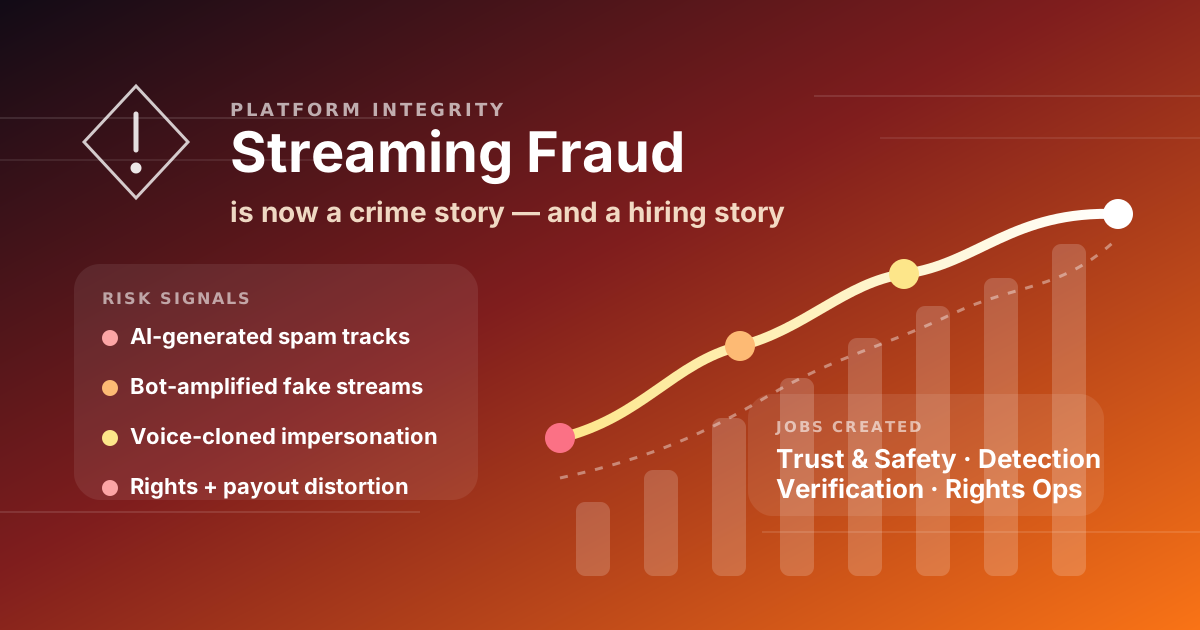
For years, streaming fraud sounded like a niche industry complaint. A little manipulation here, a little bot activity there, some shady upload behavior in the background. Annoying, yes, but still easy to treat as a side issue compared to the bigger music-tech conversation about growth, subscriptions, recommendation systems, and creator tools.
That framing no longer works.
In March, a North Carolina man pleaded guilty to defrauding streaming services out of millions of dollars by using AI-generated songs and automated bots to generate fake plays at industrial scale. Around the same time, TikTok’s SoundOn announced a new verification partnership with ACRCloud to catch unauthorized and manipulated uploads before they hit DSPs. And Deezer continued pushing its AI-detection technology into the wider music ecosystem, including a new licensing deal with Hungary’s EJI.
Put simply: fraud, impersonation, manipulated audio, and AI-generated spam are no longer edge cases. They are becoming operating conditions.
And that means something important for MusicTechJobs.io readers: one of the clearest growth areas in music tech right now may be the work required to keep the entire system trustworthy.
The Michael Smith case made the problem legible
The recent guilty plea in the Michael Smith case matters because it turned a familiar industry fear into something concrete and legible.
According to federal prosecutors, Smith used AI to generate thousands of fake songs, then used bots to stream them billions of times in order to siphon royalties from streaming platforms. The result was not just fake music getting fake plays. It was real money being diverted away from real artists and rightsholders.
That is the part worth emphasizing.
Streaming fraud is not an abstract platform-quality issue. It is a revenue-allocation issue. When fraudulent streams enter the system, they do not just create noise. They distort payouts, poison trust in the platform, and quietly move money away from legitimate participants.
In other words, fraud is not separate from the music economy. It is now competing with it.
Why this is now a hiring story
Every time a music-tech platform has to deal with fraud at scale, it creates work.
Not glamorous work, usually. But real, specialized, increasingly essential work.
The more AI lowers the cost of generating tracks, cloning voices, manipulating audio, and mass-uploading content, the more valuable the following become:
- fraud detection systems
- trust and safety teams
- catalog integrity workflows
- uploader verification
- audio fingerprinting
- metadata review
- anomaly detection
- payout monitoring
- rights verification
- human review operations
That is the hiring story.
The next wave of music-tech employment is not just about building new creative tools. It is also about building defenses.
Upload verification is starting to look like core infrastructure
One reason this shift feels more permanent is that platforms are beginning to harden their ingestion layers.
SoundOn’s new partnership with ACRCloud is a good example. The point is not simply to identify exact copyright matches after the fact. It is to detect manipulated or unauthorized tracks before distribution, even when those tracks have been altered by speed or pitch shifting. SoundOn is also layering in stricter uploader identity checks and human review.
That is notable because it signals a change in posture.
Music platforms and distributors are moving away from a looser “ship first, clean up later” logic and toward something more like verification-first infrastructure. If you are distributing content at scale, especially in an era of AI-assisted manipulation, you cannot rely on downstream cleanup alone.
That creates room for people who understand how to build and run:
- pre-distribution review systems
- content recognition pipelines
- risk scoring workflows
- uploader identity verification
- hybrid human-and-automated review environments
Those are serious product and operations problems. And they are becoming more important, not less.
AI detection is becoming a product category, not just an internal safeguard
Deezer’s latest move points in the same direction.
When a streaming service starts licensing its AI-detection technology to outside rights organizations, it is sending a very clear signal: this problem is big enough to justify standalone tooling.
That matters because once something becomes a product category, it usually creates a broader employment surface around it.
In this case, that likely means more demand for people working across:
- AI-content detection
- classification systems
- policy and compliance
- content labeling
- rights enforcement
- B2B music-tech tooling
- detection QA and model evaluation
This is one of the more overlooked shifts in music tech right now. A few years ago, the commercial opportunity around AI in music was almost entirely framed around generation. In 2026, detection and verification look increasingly monetizable too.
And if those capabilities are going to be sold, integrated, audited, and maintained across the ecosystem, that creates jobs.
The fraud problem is bigger than bots
It is tempting to think of streaming fraud as a pure bot story. That is only part of it.
The broader problem now includes:
- AI-generated spam tracks
- manipulated audio versions of copyrighted works
- voice-cloned impersonations
- fake or misleading artist attributions
- fingerprinting gaps that bad actors exploit
- bulk-upload behavior designed to overwhelm review systems
- false copyright claims and ownership disputes
The Murphy Campbell case reported by Music Business Worldwide is a useful reminder here. That story was not just about AI-generated covers appearing under a real artist’s name. It also involved content claims and system gaps around fingerprinting and verification.
That matters because it shows how these problems start to blend together.
Fraud, impersonation, moderation, metadata quality, rights verification, and creator protection are no longer separate departments in neatly labeled boxes. In practice, they are converging into one messy infrastructure challenge.
Which means companies need people who can think across those boundaries.
The skills that matter next
So what kinds of people become more valuable as streaming fraud becomes a larger operational and legal issue?
A few stand out.
1. Trust and safety specialists
People who can build policies, review workflows, enforcement systems, and escalation paths for content abuse.
2. Applied ML and detection engineers
People who can work on anomaly detection, content classification, pattern recognition, and fraud scoring systems.
3. Rights and catalog operations talent
People who understand metadata, ownership verification, fingerprinting gaps, and catalog integrity.
4. Product managers for verification systems
People who can translate messy abuse problems into usable internal tools, review queues, uploader workflows, and platform controls.
5. Platform integrity and payments analysts
People who can spot suspicious behavior, connect usage anomalies to payout risk, and reduce financial leakage.
6. Creator support and dispute-resolution ops
Because when systems fail, artists need humans who can actually investigate, explain, and fix the damage.
These are not hypothetical jobs. They are already emerging in pieces across platforms, distributors, rights organizations, and infrastructure vendors.
Why MTJ should care
MusicTechJobs.io sits in a useful position here.
A lot of music-tech coverage still chases the shiny part of the story: the newest AI tool, the latest creator app, the next consumer-facing feature. Those matter, but they are not the only story worth following.
The more strategic story is the one underneath: what kinds of systems now need to exist for the music business to function at scale?
That is where streaming fraud becomes such a strong editorial lane.
It touches:
- platform infrastructure
- trust and safety
- music rights
- AI detection
- distribution operations
- creator protection
- analytics and revenue integrity
And crucially, it turns all of those into a career conversation.
The unsexy work is becoming essential work
There is a broader lesson here.
As industries mature, some of the most important jobs move away from visible growth and toward invisible stability. Music tech may be entering more of that phase now.
The platforms still need product innovation. The creator economy still needs new tools. AI will keep reshaping how music is made and distributed.
But alongside all of that, the ecosystem increasingly needs people whose job is to stop the machine from being gamed.
That may not be the most glamorous version of music tech. It is, however, one of the most durable.
If the past few months are any indication, streaming fraud is no longer just a scandal, a compliance headache, or a PR problem.
It is becoming a hiring category.
Sources
- US man pleads guilty to defrauding music streamers out of millions using AI — The Guardian — March 21, 2026
- TikTok’s distro service SoundOn cracks down on manipulated audio via ACRCloud partnership to intercept unauthorized tracks — Music Business Worldwide — April 2, 2026
- Deezer licenses AI music detection technology to Hungarian rights organization EJI — Music Business Worldwide — March 27, 2026
- A folk musician had her voice cloned by AI – and her recordings claimed by a copyright troll. Welcome to 2026. — Music Business Worldwide — April 5, 2026